B & K AVR 507 Series 2

J

jlr

Audiophyte
I have a B & K AVR 507 Series 2 unit and one of the power supplies has gone bad. Since B & K is no longer around, parts are not available. Any suggestions for what to do with this unit as for as repair or use in conjunction with other amplifiers, or is it time to move on. The unit was set up to power 5 speakers in theater setting and 2 speakers for stereo listening in a separate room.
 
lovinthehd

lovinthehd

Audioholic Jedi
If the part isn't available repair may not be possible unless that particular power supply is available outside of BK. It's like 24 years old, tho and personally I'd move on....otoh if you have pre-outs that still work fine you could add external amps....
 
H

Hobbit

Audioholic Chief
I would move on. So much has changed since that was released. A modern 7.2 channel Denon for instance will come with room correction, decode more formats, more input/output options, and have a host of other useful features. All around $1k.
 
TLS Guy

TLS Guy

Audioholic Jedi
I have a B & K AVR 507 Series 2 unit and one of the power supplies has gone bad. Since B & K is no longer around, parts are not available. Any suggestions for what to do with this unit as for as repair or use in conjunction with other amplifiers, or is it time to move on. The unit was set up to power 5 speakers in theater setting and 2 speakers for stereo listening in a separate room.
The unit is a boat anchor in need of a one way trip to the recycling center.
 
Eppie

Eppie

Audioholic Ninja
That's strictly an analogue unit so I would only consider repair if you have no intention to ever add any digital sources. As long as one one the transformers has not gone, the power supply should be repairable but what else could be wrong and how much money do you want to put into a 20 year old AVR? Only issue I can foresee is what are you using for source material? Newer AVRs have a limited number of analogue inputs. If you have a lot of analogue sources, you may run out of inputs, so I would research that first.

You also have not mentioned what type of display you are using. If it is an analogue display that could be an issue because modern AVRs all use digital HDMI outputs. Finding an AVR with component out will be a challenge. Sometimes when one piece goes it may involve a complete system upgrade. When I replaced my TV, I also replaced the AVR at the same time since both pieces should support the latest HDMI spec.
 
TLS Guy

TLS Guy

Audioholic Jedi
That's strictly an analogue unit so I would only consider repair if you have no intention to ever add any digital sources. As long as one one the transformers has not gone, the power supply should be repairable but what else could be wrong and how much money do you want to put into a 20 year old AVR? Only issue I can foresee is what are you using for source material? Newer AVRs have a limited number of analogue inputs. If you have a lot of analogue sources, you may run out of inputs, so I would research that first.

You also have not mentioned what type of display you are using. If it is an analogue display that could be an issue because modern AVRs all use digital HDMI outputs. Finding an AVR with component out will be a challenge. Sometimes when one piece goes it may involve a complete system upgrade. When I replaced my TV, I also replaced the AVR at the same time since both pieces should support the latest HDMI spec.
Those units are absolutely no use "to man nor beast" any longer. Even if he did fix the gear connected to it will be failing. Its junk and there is no doubt about it.
 
Eppie

Eppie

Audioholic Ninja
That's not a fair assessment. You're assuming that the op can afford to replace the ENTIRE system due to one failed component. That might be the optimal solution for gear that old but not an assumption I would make. We need a detailed list of what the op owns to know whether it's worth getting a little more life out of the current setup. I had to save up for years to purchase a complete system. Repairing one component could extend the life of the system enough for someone to do that. If the TV / projector is also that old then we're potentially talking thousands of dollars.

If the TV has HDMI and component inputs then a new AVR would be best. If you look at the higher end of Denon and Marantz AVRs, some models still have a decent number of analogue inputs, but the choices get more limited each year.
 
TLS Guy

TLS Guy

Audioholic Jedi
That's not a fair assessment. You're assuming that the op can afford to replace the ENTIRE system due to one failed component. That might be the optimal solution for gear that old but not an assumption I would make. We need a detailed list of what the op owns to know whether it's worth getting a little more life out of the current setup. I had to save up for years to purchase a complete system. Repairing one component could extend the life of the system enough for someone to do that. If the TV / projector is also that old then we're potentially talking thousands of dollars.

If the TV has HDMI and component inputs then a new AVR would be best. If you look at the higher end of Denon and Marantz AVRs, some models still have a decent number of analogue inputs, but the choices get more limited each year.
The problem is that the power supply is very complex and packed with ICs, which you can bet are NLA by now. The circuit diagrams are available, but I don't find a service manual with test procedures. Unless the OP is very skilled in repair, I don't see paying a tech to sort it out would be in any way cost effective. I certainly would not tangle with that. I think the chances of successful repair are slim to none. Any funds are much better spent on a newer unit.
 
Eppie

Eppie

Audioholic Ninja
My sources yield the same service manual. Too bad it does not include PCB layouts. We're assuming the op is correct and it's a power supply issue but there is no mention of how he arrived at that conclusion. It also depends on his location as to whether there are any qualified techs in the area. AVRs are a pain to service because of the multitude of PCBs but there are plenty of YouTube videos showing that it can be done.
 
TLS Guy

TLS Guy

Audioholic Jedi
My sources yield the same service manual. Too bad it does not include PCB layouts. We're assuming the op is correct and it's a power supply issue but there is no mention of how he arrived at that conclusion. It also depends on his location as to whether there are any qualified techs in the area. AVRs are a pain to service because of the multitude of PCBs but there are plenty of YouTube videos showing that it can be done.
Honestly Eppie, an old analog AVR is really not worth time or investment. It has had its day and needs a decent burial. The Analog AV era was brief. I got into it just prior to the dawn of HDMI. I dropped my analog AVP like a "hot potato" even though it was two or less years old. It was the correct decision. Really the only reason to have one is for museum display and nothing else. However there are a lot more interesting items to preserve than analog AVRs, or AVPs. Essentially home AV dawned as the digital era really came of age.
 
Eppie

Eppie

Audioholic Ninja
Honestly Eppie, an old analog AVR is really not worth time or investment. It has had its day and needs a decent burial. The Analog AV era was brief. I got into it just prior to the dawn of HDMI. I dropped my analog AVP like a "hot potato" even though it was two or less years old. It was the correct decision. Really the only reason to have one is for museum display and nothing else. However there are a lot more interesting items to preserve than analog AVRs, or AVPs. Essentially home AV dawned as the digital era really came of age.
Not a word from op any way. Curious what route he will choose.

FYI, I came across some old manuals this weekend. I kept what paperwork I could find on my father's old sound system that came with the house. He bought the house from a German friend who was a real renaissance man. One of those guys that had worked all over and could do just about anything. He built the audio system himself and the amp was a Scott 200 series from a kit. I think it was the Scott 233 as I recall the power rating being around 30W per channel. I still have the instruction manual for assembling the amp and the matching tuner.
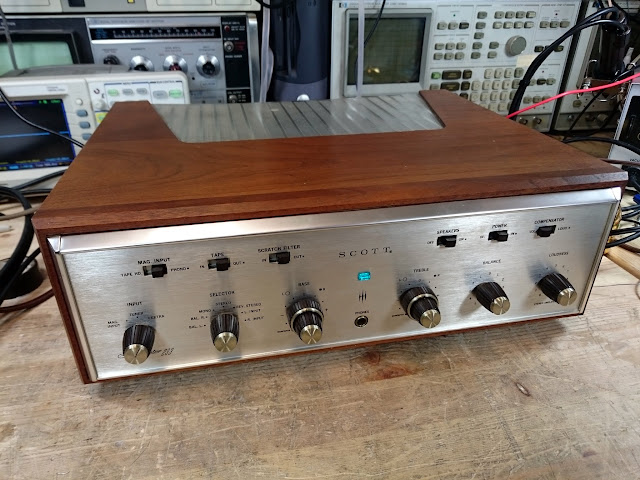
Scott_233.JPG


I also found a pamphlet on his speakers. They were all Electrovoice drivers, likely from the 1960's, same as the amp. He used both a horn midrange and horn tweeter paired with a 12" or 15" woofer. Those speakers were highly efficient as you could achieve reference level volume with just that 30W tube amp. I could never find the plans for the speakers but closest I could find on-line was the Electrovoice Georgian. Horn drivers in the top and the woofer in an open back corner cabinet design.

Electrovoice Georgian.jpeg


His was not the Georgian because the woofer enclosure was very different and the Georgian used a large single horn. I distinctly remember that in his enclosure the woofer was downward firing into a chamber which opened up towards the front of the speaker and then had a completely open back. I think the woofer fired through a semi-circular opening, if that makes any sense. I've been unable to find anything remotely like it in my researches but I will never forget just how good those speakers sounded.

He was a big classical music fan and had a rare tape (reel to reel) recording of the 1812 overture. Verdinut was kind enough to find the recording for me and thinks it was the one originally recorded on the Mercury label, with Antal Dorati conducting the Minneapolis Symphony Orchestra. The cannons would go off with authority on that old system. I used to get chills when the finale played. Sadly, when he sold the house he took the reel to reel and recording with him and it eventually went to another collector.

1812-1.jpg
 

Latest posts

newsletter

  • RBHsound.com
  • BlueJeansCable.com
  • SVS Sound Subwoofers
  • Experience the Martin Logan Montis
Top